Another public sidewalk expropriated by a developer.
This is the site of the giant mess coming in the 700 Block of South Harbor Boulevard – a behemoth brought to us courtesy of our present City Council, who approved this monster unanimously.
I don’t get it. There’s nothing difficult about a contractor keeping a sidewalk open. It just takes a City that cares about the people who live here and use the public sidewalks, instead of bending over backwards the the developer of another massive, San Quentin-like apartment block. The only thing missing will be the gas chamber.
And now I present to you humans the nominations in the supremely important category of The Ghost of Fullerton Past. Why is this important? As an expert on the subject of ghosts myself, I can tell you that Fullerton never seems to be rid of hauntings by former inhabitant of the worst ilk. My former mistress was nominated in 2009 and finally took the home the prize in 2012, before she managed to re-materialize in something approximating corporal human form. Usually the nominees are culled from the large stock of horrific departed repuglicans such as Linda LeQuire who revisit you near every election time to promote this or that non-entity propped up on the campaign dais by Ed Royce.
This year was no different: the nexus was largely the misbegotten campaign of Larry T. Bennett, and how the grisly Ghosts of Fullerton Past manifested themselves to support the insupportable. The first five entries distinguished themselves by clambering up onto the rickety Bennettmobile.
Buck Catlin. Buck Catlin is also a former nominee in this category. His claim to fame was getting recalled in 1994 by voting to impose a completely unnecessary utility tax upon the populous.
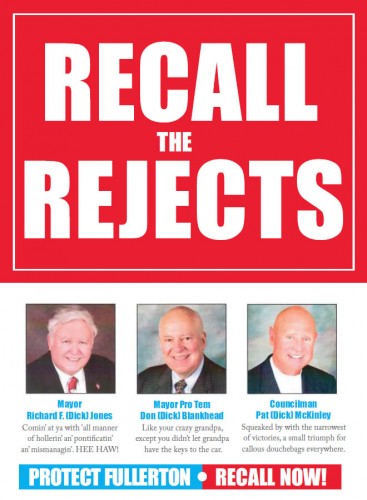
The Three Bald Tires. Yes, you know them also as the Three Tree Stumps, the Three Dead Batteries, etc. Mssrs. Jones, Bankhead and McKinley were recalled in 2012 for their deplorable behavior in the aftermath of the Kelly Thomas killing, and their die-hard love of the illegal water tax. They re-emerged on the political scene this fall, thinking their estimable reputation would help Bennett. More than likely it hurt, and hurt badly; but no sympathy for Ol’ Schlep Larry – he obviously solicited their endorsements. Pathetically, each of these burned out bulbs brought along his spouse to the party to join in yet another electoral humiliation.
Lou Ponsi. This specter popped up as a writer for the utterly lame and publicly funded Behind the Badge, touting the good works of our cops, specifically in bribing kids with a Thanksgiving dinner to be good little barrio tykes. Nobody involved seemed to pick up on the rather demeaning condescension involved in this display, but FFFF did. Ponsi spent many years regurgitating the lamest and most insipid sort of pabulum for the local Register rag, swallowing everything he was dished out like a hungry little bird, and never asking a single probing question about the behavior of the Fullerton Police Department and its employees. Not one. Ever. None. Nada.
There they are, human Friends. A scarier rogues gallery shall ye never find. Them’s your potential winners. And by winners I mean we all lose.
First is the caught-on-video assault and battery/false arrest of an FJC kid by an arrogant old sonnovabitch named Dino Skokos, an ex-cop with a “disability” retirement and obvious anger management issues. The FJC mush-mouth machine went into immediate Orwellian production mode, including hiring a law-firm that specializes in defending government agencies to conduct an “investigation.” Ha. I lift my leg on them.
If there’s a bottom to this, you won’t get there…
Then, of course, there is the Case of the Mysterious Disappearing City Manger, in which Mr. Joe Felz, while motoring home from a series of parties, jump a Glenwood Avenue curb, uprooted a tree and tried to drive off. Stopped by the cops, he flashed his stay-out-of-jail card, got a pass and a ride home. The citizenry was promised an “independent person” investigation and was told cryptically of some sort of “ongoing (or potential) criminal investigation.” No details have been forthcoming and nobody is holding his breath waiting to ever see any.
Hardhat Man. everybody is familiar with the politician who makes himself ridiculous by wearing an inappropriate hat. The result is always cringe-worthy. Here is your esteemed city council person Doug “Bud” Chaffee making like a construction worker. The little lapel flag is precious. We are in the presence of a patriot.
No comment
Medusa Flory. Sweet effervescent, glow-in-the-dark Jebus! This horrifying rendition of my former mistress makes me want to barf up my kibble. Such things should not be inflicted upon the living…or the dead. Grrrrr.
Poor Sappy
Sappy McTree. Poor Sappy McTree. Never hurt a fly. And I never even got a chance to pee on him. Ah! Only the good die young.
Auld lang syne…
Happy Joe. This image was used so often by FFFF that I almost got tired of it, but never did. Joe is gone now, but his happiness lingers on – especially in downtown Fullerton.
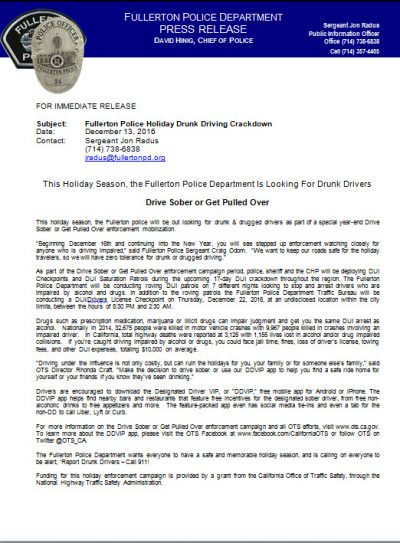
Once again the Boys & Girls in Blue have decided to insult the residents of Fullerton with a poorly timed Press Release via the F.P.D. Facebook Page where they tell that we need to “Drive Sober or Get Pulled Over” and that they’ll be “stepping up enforcement” of impaired driving laws.
One Set of Rules for You…
This Press Release is actually dated yesterday, 13 December 2016, the EXACT same day that it was announced at the Special City Council Meeting that the City Manager, Joe Felz, has left his position with the city. Weepy words from Jennifer Fitzgerald notwithstanding we know that Felz left owing to his own alleged D.U.I. Hit-&-Run that F.P.D. and the City Attorney are still attempting to cover up with boilerplate legal obfuscation and the myth of an ongoing investigation.
From the Press Release;
“We want to keep our roads safe for the holiday travelers, so we will have zero tolerance for drunk or drugged driving.”
F.P.D. will have zero tolerance. Zero! None I dare say.
Unless of course you’re part of the upper echelon of our City’s Bureaucratic Bureaucracy and can get the Police Chief on speed dial.
I figured the award for most clueless response to the Felz departure would go to Fitzgerald & Flory for their nonsense praise but this press release might take the cake. To be fair the F.P.D. probably didn’t know that Felz was on the way out when they wrote this little public service announcement but they certainly knew of their own culpability in the continuing culture of city corruption.
Word on the street is that City Hall is glad to be rid of Felz and now they’re just itching to get rid of his sycophantic entourage that continues to make city life miserable. Stay tuned as we might be able to help with some of that as time passes. If any intrepid City Employees want to help foster some more changes you know how to reach out to us here at F.F.F.F..
Enjoy as our Lobbyist-Mayor reads outgoing City Manager Joe Felz’s out-of-a can valediction.
Heartwarming, huh? There is no doubt Ms. Fitzgerald is sorry to see Joe go, but the reasons may have more to do with exercising authority in Fullerton than in any heartfelt sentiment. The important part of this speech, however, is in her description of Felz’s contributions to Fullerton and his legacy. These are important matters to Fitzgerald, as re-writing history always is to politicians.
Note how she credits Felz with bringing Chief Danny on board to “reform” the police department. And how he has masterfully handled the West Coyote Hills shambles, wherein a City government just gives its resident a big fuck you. Even his role in the everlasting Hillcrest Park embarrassment is embellished as some sort of grand victory.
Some people may be forgiven for refusing to accept this self-congratulatory nonsense as they address themselves to some obdurate facts. Such as refusing to reduce personnel, even as Redevelopment was shut down. For outsourcing graffiti removal but keeping the employees on the payroll. For four years of red ink baths to backfill an unbalanced budget. Hiring “Chief Danny?” The man who denied the obvious Culture of Corruption in the FPD. The man who claims to have watched the Kelly Thomas video 400 times, and who let the goons who killed him compare notes and re-write their reports? The man who promoted the only target of the Gennaco report – Goodrich. The man who covered up Felz’s Wild Ride Home on his next to last day of work? Is this supposed to be some sort of sick joke?
And yet for us citizens, no word on what really happened in the early morning of November 9th 2016; no word on what sort of “ongoing criminal investigation” is being pursued, if any; no word on what, if anything the DA has been asked to review.
Well, don’t worry Friends. We will be pursuing the details of Felz’s departure to see what sort of specifics may have been memorialized. And we will not give up getting those cop video records of the night when our former City Manager drove off the road, tried to get away from the scene of an accident, was stopped by the cops, and then given both a pass and a free ride home.
One of our well-placed sources in the City administration has informed us that on-leave City Manager, Joe Felz will be quitting permanently soon, even as conversations now spin around who will replace Felz. Is this true? It has the ring of truth to it.
Speaking of spinning, Felz spun off the Glenwood Avenue in the early morning hours of November 9th, ran over a tree and tried to drive away. The cops on hand smelled alcohol but for reasons that have not yet been revealed, administered no breathalyzer test and instead drove Felz home.
The voice wasn’t soothing, but the words weren’t clear.
The City Attorney has been trying to protect Felz with illegal bogus claims of “personnel matters,” so that excuse would soon be gone if Felz flees the scene. Then there’s the matter of the rather bizarre “ongoing criminal investigation,” that some folks reasonably think is nothing but another dodge to avoid releasing incriminating video and audio records that were made when the cops arrived at the crash scene. No one has even bothered to explain to the public what possible crimes were committed, or who may have committed them. And of course our City Council members have not expressed any curiosity about that, either. Sooner or later our mush-mouth City Attorney is going to have to admit a big problem with his “criminal investigation” yarn, to wit: nobody was arrested that night. No evidence of drunk driving was collected. We don’t even know if a citation was issued.
When Felz goes, he will save the the taxpayers the cost of that so-called “independent person investigation” that the City Attorney thoughtfully cooked up to stall and obfuscate the matter. If so, it will be the one and only time Felz ever saved the taxpayers anything, and that going out the door.
Of course the open question is this: what sort of windfall will be offered by our ever-helpful council to grease the skids of Felz’s departure? If he quits he won’t get his guaranteed payola, but the circumstances of his Wild Ride may make that a moot point.
Whatever happens, rest assured, we will told as little as possible, as late as possible.
In the first installment of this two-part series we saw examples of how a mere two downtown Fullerton bars (one illegally operating as a night club) had racked up a massive inventory of misdeeds, amounting to hundreds of cop calls in a few years. Just imagine how tough it is for the Fullerton Police Department to manage all this madness, night after night. And what happens to cop service calls in the rest of the city. Poor cops, right?
Yet before we shed any tears over the FPD and the horrible burden they bear, let us contemplate a “story” from the cop union website that glowingly talks about the special relationship that exists between downtown booze peddlers and our boyz in blue. Here are some choice quotations from the article:
Business in downtown Fullerton is booming.
Thousands of people flock from all over Southern California for the food and atmosphere – and to have a good time.
Police officials want to keep it that way.
In downtown Fullerton last year, officers made 562 drunken driving arrests, including 13 DUI crashes. There were also dozens of assaults.
“We could put 100 cops downtown, but we’d be swatting flies,” said Lt. Andrew Goodrich. “We want to work together to solve this.”
Added Police Chief Dan Hughes: “We want downtown to continue to flourish.”
Slidebar owner Jeremy Popoff had already convened a group of owners, calling it the “Downtown Restaurant Association.”
Do you see the absurd disconnect? Booming, flourishing business? Sandwiched between the happy horseshit talk are the startling statistics of our downtown, open-air saloon. The police are not only tolerating Crazytown, a situation they admit they can’t control, they are aiding-and-abetting it. Why? We certainly know that some bar owners like Popoff are politically connected – his place operates without the CUP the City legally requires of a night club. Then there are the recurring and disturbing stories about cops getting free food and drink at some of these bars – like Popoff’s place. These are stories that nobody has denied.
So are the cops just trying to make the best of a bad situation, or has the culture of the department finally become as gin-pickled with downtown booze as the rest of the City political establishment? I believe the department has enjoined a pretty sick symbiotic relationship with the downtown culture. And notice how the good ladies of MADD, the FPDs 5th Column, have never been mobilized against this massive affront to sober driving? Coincidence? I think not.
The closer you look, the worse it looks…
It’s obvious that there is zero political will from our city council to do a damn thing about the problem they created over the years. Just the reverse, in fact. Notice how our council unanimously agreed to carving up downtown among five separate council districts so as to dilute the influence of actual voters in that undeniable “community of interest?” The ballot statement supporting that mess was written by none other than our Lobbyist-Mayor, Jennifer Fitzgerald. Hmm.
The sign of fine dining. And drinks. Don’t forget the drinks. That’s where the real dough is.
As for Popoff, he can join with his fellow merchants of martinis and call themselves a”restaurant association;” they can pretend to play nice even while they are racking up ever-lengthening lists of police calls; what they can’t do, at least now that people are finally paying attention, is pretend that their operations aren’t draining financial resources from the average Fullerton family and putting it in their own bank accounts.
The annual downtown fiscal deficit to the taxpayer is well over a $1,500,000 – that’s ten bucks for every man, woman and child in Fullerton; somehow business is booming – but not the City’s General Fund.
And now, returning to the “article” cited, above: let’s have our new amigo, Mr. Gregg Honour, the control-your-bars consultant, whose attention has been drawn to downtown Fullerton and to FFFF, take us home:
Gregg Hanour, former owner of the Shark Club in Costa Mesa and author of “A Business Approach to Reducing Drunk Driving,” said police departments typically conduct undercover stings to build a case to remove a troubled bar.
“You’re lucky,” he told the bar owners. “Your police department wants to work with you.”