On Tuesday’s jam-packed agenda (more on that later) one item stands out: consideration of approving TEFRA bonds. It’s been continued from the June 16th meeting.
TEFRA stands for Tax Equity and Fiscal Responsibility Act, and authorization permits a little-known statewide housing agency to issue bonds that will provide $180,000,000 for an unknown non-profit entity to buy and remodel two huge apartment complexes over by Cal State Fullerton. The projects will subsequently be partially restricted to low and medium income renters.
The staff report goes to great pains to explain that the City is in no way responsible for the debt incurred; see, it’s more of a procedural formality that the municipality puts its stamp of approval on the debt issuance.
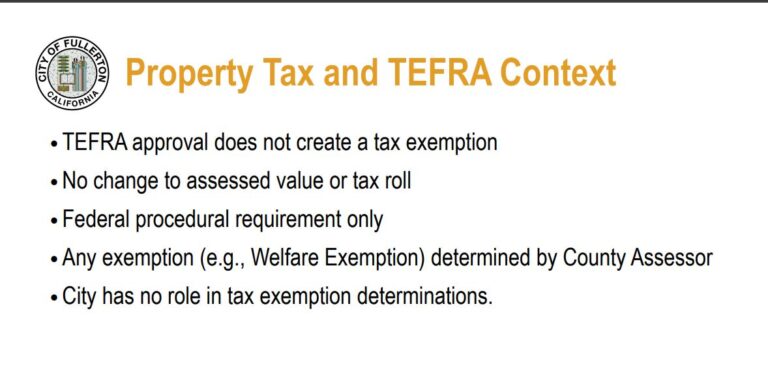
Anyhow, questions were asked by the Council in June about the impact to property tax revenue, and as usual that inquiry was met with blather:
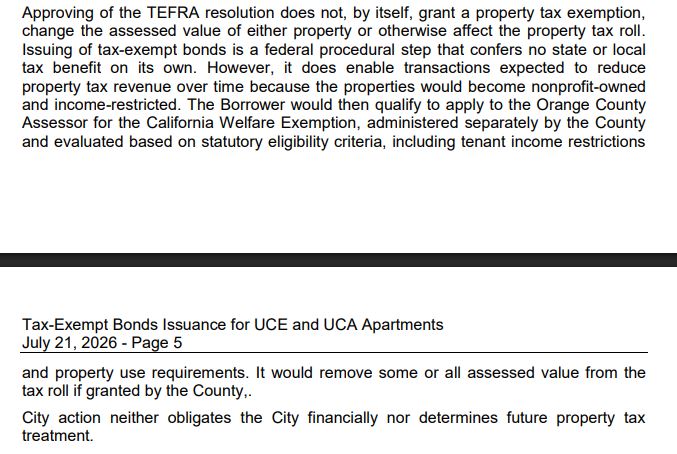
Since the County Assessor is the guy who grants tax-exempt status on 501(c) “affordable housing” the City itself has no part in that, and so staff explains that this action, per se, won’t lower tax revenue. But that’s a distinction without a difference, for clearly one purpose for investors in these acquisitions is to harvesting the benefit of lowered property tax. It’s gotta be in their development pro forma. The staff report says a little about possible lowered revenue, later on:
In other words two huge apartment projects will inevitably generate less of the property tax than they generate now, but still require all of the city services, from infrastructure to police and “fire fighters.”
And that’s not all, Friends. The units thus restricted will not count towards Fullerton Regional Housing Needs Assessment (RHNA) quota – the idiotic number coughed up behind closed doors by the unaccountable bunglers at the Southern California Association of Governments. Here’s how the staff report explains it.
Well, that’s a kick in the head. So we still need another 13,000 units, per the SCAG quota. I have no idea what the City’s “affordable housing goals”are and I don’t see a reference to a supporting document that substantiates any of this.
To me this is a lose-lose situation unless your mission in life is to support the Affordable Housing Industrial Complex by subsidizing a tax reduction. It isn’t just about providing “affordable” housing. It’s about taxpayers ultimately paying more for municipal services to satisfy some hazy “goal” somewhere.
Fullerton’s Observer boohoo brigade will no doubt rejoice at this endeavor because, ya know, a housing “crisis” requires public subsidy and taxes really will fix everything. And doing something, even if it makes no sense, is still doing good.
Why write about news when you can try to make your own! (Photo by Julie Leopo/Voice of OC)
Yes, indeed. In an editorial masquerading as some sort of news, Fullerton Observer sister Sikita Kennedy explained the failure of government and the ways in which that failure is dressed up to look like victory. This article appears to be an AI generated creation since the estimable Satskia has never shown this sort of perspicuity in the past, but, whatever. After you weed out the jargon some fundamental management truths emerge.
The topic of course is something almost nobody gives a rat’s ass about: getting rid of bike lockers at the train station, the reason given that they are underused. The awkward title shouts out “Fullerton’s Bicycle Lockers Spark Controversy Among Cyclists” as if an inanimate object has such puissance. Naturally, it’s the removal of said lockers that is causing Siska herself grief; not a solitary cyclist is interviewed or quoted in her essay.
But I digress. The topic is inconsequential, but the analysis of failure is quite remarkable and completely uncharacteristic. Kennedy seems to have finally discovered the cultural behavior of government bureaucracies that we have known all along. Let’s enjoy some of the fruits of her editorial labors:
Organizations in crisis rarely announce themselves as such.More often, they produce charts, reports, and performance metrics that tell a reassuring story — one that, on closer inspection, was shaped by the same decisions it purports to evaluate. This is one of the quieter dangers of institutional mismanagement: it doesn’t just damage an organization, it can generate the evidence that justifies its own continuation.
How perfectly true, and so descriptive of almost every staff and study report ever produced in Fullerton. The classic dodge is to answer a question that nobody asked.
“…a dispute over bicycle lockers is offering a textbook example of how low performance, manufactured by neglect, gets cited as the reason to eliminate the very thing being neglected.
Yes, indeed. Sort of sounds like the death-march noise ordinance fiasco, doesn’t it, wherein City failure to enforce codes results in the push to abandon the process of code enforcement altogether.
When managers make poor decisions, they typically face two options: change course or defend the course they’re on. Defense, in institutional settings, almost always involves data. The problem is that those same managers often control what data gets collected, how it gets measured, and how it gets reported.
Good Lord, Satkia, has had her come to Jesus revelation! The truth may yet set her free! How often have we seen a circling of the wagons, the manipulation of information to reinforce the error? Mostly data collection, crooked or otherwise, isn’t even necessary. Convoluted rhetoric often does the trick. Option number one never takes place.
A leader who has misallocated resources will tend to measure success in ways that don’t reveal the misallocation. A department head who has pursued the wrong strategy will frame performance indicators around the metrics where progress is easiest to show. Over time, the organization’s entire information infrastructure bends toward confirming decisions already made.
This is something we’ve seen time and time again. Throw out the jargon and it means this: “look over there.” The misdirection is so common as to be commonplace. This is what will happen when the City’s disastrous “fire fighter” ambulance driver chickens come home to the proverbial roost.
This is the classic mismanagement data trap: measuring outputs rather than outcomes, and then using those outputs to validate the decisions that produced them.
Amen, Sister, testify!
The “data trap” of measuring outputs was nowhere better seen than on the horrendously useless Trail to Nowhere, where the efforts were all about building something expensive and then patting yourself on the back for…building something expensive. But that wasn’t about a few piddling bike lockers, no, but the waste of $2,500,000, an irony lost on the Fullerton Observer editorial staff of two. The Observer Sisters will never expend a moment’s time worrying about actual users (or complete lack of same) on the “trail.”
One of the most common tools in this playbook is selective periodization — choosing a start date for measurement that makes current numbers look favorable by comparison. Applied to civic infrastructure, this often means measuring usage after a program has already been allowed to deteriorate, rather than tracking the arc from functional to neglected.
How funny. Siskia has had her epiphany, alright, but it sure is a selective enlightenment. Remember when staff tried to keep the ridiculous Waste on Wilshire going by citing low traffic on Wilshire after the street had been closed!
Organizations under poor leadership often commission external reviews that appear to provide independent accountability but are structured to confirm decisions already made. The questions given to reviewers shape the findings, and the questions come from the people who need favorable findings. The result carries the authority of objectivity while functioning as a mirror.
Let’s consider the very recent Grant Thornton report whose results were meant to cauterize a huge embarrassment without naming a single culprit or a single systemic failure. No outcries from the Observers, of course.
Cities do this too — with traffic studies, usage audits, and infrastructure assessments that are framed around the conclusion leadership has already reached. Whether that’s what’s happening with Fullerton’s active transportation data is a question advocates would do well to press publicly.
They sure do, Sitka. Who are you supposed to believe, your commonsense or the experts we have hired to back us up? Ahem, remember the “experts” hired to produce pro tax findings, pro development findings, pro this or pro that findings? In fact data supporting everything that the City Manager who hired them wants. The latest examples is that “traffic study” for the overbuilt Harbor/Hermosa project that will never in a million years stop the project as designed, from being built.
The antidote to data shaped by mismanagement is not more data — it’s differently sourced data, with different incentive structures attached to it. Independent audits are conducted by parties with no relationship to the decisions being evaluated. Performance metrics set before interventions begin, not after. Usage data is examined in the context of program accessibility, not in isolation.
Great Caesar’s Ghost! What a splendid statement of objective accountability and something that should be happening, at least occasionally, and not on some silly bike lockers, but on real issues where millions are spent, from hiring ambulance drivers to deciding if anybody is now going to use a new but previously failed park; on weather there is a chance in hell that anybody would patronize a “boutique” hotel at the Transportation Center.
There is a vast irony in the Observer’s new-found demand for objective standards to promote accountability – exactly the thing government employees dread. See, it’s the squalid world of professional management, and such accountability is not to be applied to government bureaucrats who are made of a finer material. They are working for us, see, and have a noble calling not to be subjected to accountability.
And it’s deliciously ironic that the new Observer spirit has been discovered due to some footling bike lockers, and not the decades long history of Fullerton disasters that nobody but FFFF has chronicled.
Might Sciatica Kennedy’s observations and suggestions be applied to future Fullerton mishaps? Bet not. But let’s enjoy them while we can.
At tomorrow’s Fullerton City Council meeting, agenda item #1 features a report by the firm of Grant Thornton Risk Advisory Services. They will present what the City is calling a “special fiscal audit.”
What does that mean, and what are the results? Unknown because there is no staff report – not even a little introductory prose. This is in keeping with former City communications regarding the recently revealed erroneous assignments of millions into General Fund reserves – money that was supposed to go elsewhere. The last post FFFF did on this subject in March pointed out the condescending gobbledygook press release that emanated from City Hall. I believe this “audit” was commissioned to address the big errors and allay fears that some sort of malfeasance took place.
I hope that Messrs. Shawn Stewart and Charles Mayes (CPA) of Grant Thornton will present something real simple. Like maybe a diagram, or a flow chart to explain how these bogus transactions took place. Where did the money come from, where did it go, and when was it fixed? One hopes there will be no verbal or logical gymnastics to dodge assignment of responsibility. Does one hope in vain? And of course please let us know:
What are the true balances in General Fund and Capital Improvement Reserves.
Item #12 on the agenda is a report on staff vacancies and retention recruitment efforts required, as usual, by a nosey and intrusive State legislature. I’m not sure what the purpose of the law is, but the information contained in the report is worth considering. According to staff there are currently 65 vacancies, two thirds of which are non sworn, general public employees. 65 vacancies is about 10% of the total labor force.
In past years the vacancy rate has done as high as 25% in Fiscal Year 21/22.
Here’s the issue. How many of these vacant positions are included in the current 25/26 budget deliberations? All of them? Some cities use a “vacancy factor” in their budgeting – an estimate of how many vacancies will be unfilled in the fiscal year. Does Fullerton do this? They should if they don’t.
I also note that the labor force in Fullerton is up 7% since 22/23 even as dire predictions of the structural deficit were publicized. Why did this happen? The architect of past city budgets, City Manager Eric Levitt quit and took a higher paying job in San Bernardino last year so no answer will be forthcoming from him.
As an example of a recruitment the staff report includes this graphic from last fall:
An Associate Planner goes for $84K to $108K per annum – not counting benefits and pension costs, of course. If those are generally calculated at a modest 25% we can assume this Associate Planner will cost the taxpayers around $120,000 a year, which I think is fairly reasonable.
If we assume the average total cost of those 65 vacant positions is, say, a conservative $100,000, then we are looking at an annual cost of $6,500,000. That closes a lot of budget deficit, right there.
Pro sales tax advocates will claim there is a vital quality-of-life issue at stake, as if the number of public employees in City Halls guarantees such a concept; these vacant jobs are key to life, liberty, and the pursuit of happiness in Fullerton. The same alliance of cops, “firefighters” and local City Hall camp followers who pushed Measure S in 2020 will claim it to be so. These are the same folks who get guaranteed defined benefit pensions, step pay increases, etc. They make no sacrifices and are rarely asked to do so. That task falls upon the citizenry.
College Park is an old neighborhood adjacent to Fullerton Junior College. Back in 1979 the City designated it as an historic preservation zone. That was 46 years ago if you’re counting. The area is full of little bungalows and small spanishy looking houses. It’s a nice neighborhood even if you add in the dinky roundabouts on Wilshire – the brainstorm of Wild Ride Joe Felz, who certainly could not have navigated them on election night, 2016.
But I digress.
Cornell Avenue resident
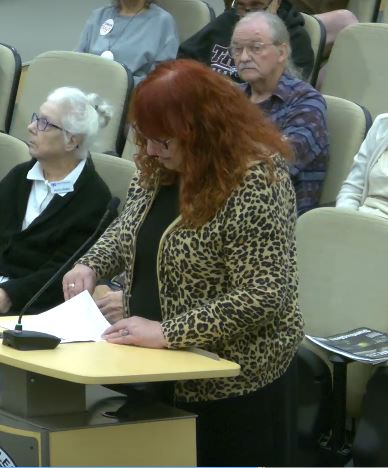
At the last City Council meeting a woman who lives on Cornell Avenue in the district complained about a building on her street under construction that was completely out of character with the neighborhood and the preservation rules, adopted in 1996, that are supposed to protect against such things. She kindly reminded the Council that she lives in D5 – Ahmad Zahra’s district.
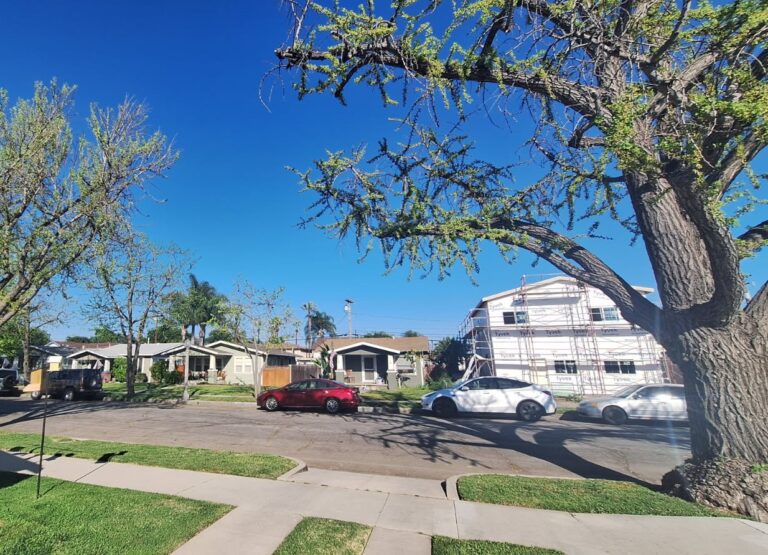
So I went over to the 100 North block of Cornell Avenue and snapped some images.
The Thing That Ate Cornell…
Now I’m not an architect, but something is awfully wrong here. Yeah, it’s a big box with cheap, misaligned windows that is completely out of scale with the houses around it. Yikes. Check out the puny little rooflet over the cheapo Home Depot door.
It may be ugly but it sure is big…
How could this happen? It looks like somebody in City Hall dropped the melon with a loud plop. As I understand it, there is a staff process for reviewing these developments. Did it occur? I don’t know. But whether it did or didn’t happen, the problem is obvious. If it didn’t, why not? If they did what sort of knucklehead(s) could have approved this?
Eyesore is right.
At the meeting Development Director Sunaya Thomas preposterously claimed this hulking monster was somehow an ADU development – meaning a mere accessory dwelling unit, a “granny unit,” and that the City had no real control over the design of the beast; and also that it was up to the owner to figure out parking for his tenants! Up to the owner?Since when?
Of course Ms. Thomas is talking out of her backside, as is so often the case. The rules for preservation in the R2P zone are called out in the Municipal Code – Chapter 15.17.60, from which I quote:
All proposed development, including the rehabilitation of existing structures, will be reviewed for compliance with established design criteria and standards, specific to the preservation zones and identified significant properties. These adopted design criteria and standards, entitled “Design Guidelines for Residential Preservation Zones,” are intended to serve as a baseline — a set of elementary guidelines — by which a proposal will be evaluated.
Here are the the guidelines, supposedly unknown to the very person in charge of applying them to new development in preservation zones:
I learned a long time ago that it’s almost impossible to make Fullerton planning bureaucrats do their jobs (see noise ordinance issues). The defensiveness and lack of shame will always prevail. But this is appalling. The rules are there to follow, not to pick and choose.
Thomas failed and failed badly. The Council was lied to on Tuesday night. Does anybody care?
Hopefully the D5 council representative Ahmad Zahra, who champions transparency and accountability, will get to the bottom of this fiasco.
The City of Fullerton has issued a press release to address the recent revelation that $10,000,000 was erroneously counted in general reserves when it really belonged in special restricted categories. Peruse this soporific and condescending verbiage and see if you can read a single reference to City employees having made a mistake, honest or otherwise.
Alternatively, take an Ambien and relax. Everything’s gonna be fine.
City of Fullerton Budget Update
At the March 17, 2026, City Council meeting, City staff presented an agenda item titled “Second Quarter Financial Report for Fiscal Year (FY) 2025–26 and Mid-Year Budget Adjustments.” The purpose of this item was to provide an overview of the City’s financial position through mid-year FY 2025–26, report on revenues and expenditures from July 1, 2025, through December 31, 2025, and present the updated financial position based on the finalized FY 2024–25 Annual Comprehensive Financial Report (ACFR). Following this presentation, the City would like to provide additional context and clarification to support a clear and shared understanding of the information discussed.
The City Council adopted the Fiscal Year 2024–25 budget on June 4, 2024, which included a planned structural deficit of approximately $9.4 million. As part of that budget, it was understood that the City would utilize a portion of its reserves—similar to drawing from savings—to balance the difference between revenues and expenditures. This approach was discussed publicly during the budget adoption process.
Throughout FY 2024–25, the City took steps to manage costs, including holding vacant positions and limiting expenditures where feasible. As a result of these efforts, the City reduced the actual year-end operating deficit to approximately $5.7 million, reflecting ongoing attention to fiscal responsibility.
At the close of Fiscal Year 2024–25, the City’s General Fund—the primary operating fund used to provide essential services such as police, fire, parks, and infrastructure—reported a total fund balance of $30.0 million. A fund balance can be thought of as the City’s overall savings. Of this amount, $19.8 million is held in the City’s contingency reserve, which serves as the City’s emergency fund to maintain services during economic uncertainty or unexpected events.
A portion of the City’s fund balance—approximately $10.2 million—is categorized as restricted, committed, or assigned for specific purposes. During the fiscal year, approximately $2.7 million was more clearly designated within these categories, increasing the allocated portion of the City’s savings from approximately $7.5 million to $10.2 million. These funds support important community priorities such as capital improvements, General Plan updates, Downtown parking, and street and infrastructure improvements, including road repairs. These funds remain part of the City’s overall financial resources but are set aside for their intended purposes.
Additionally, a $2.9 million prior-period adjustment identified through the City’s independent audit was related to the proper classification of assets between the General Fund and the Successor Agency. This adjustment ensures that funds are reflected in the appropriate account in accordance with accounting standards. The funds were not lost or misspent, but rather properly reallocated.
At the end of FY 2024–25, the City’s contingency reserve was approximately 14% of annual General Fund expenditures, which is above the City’s minimum policy requirement of 10%, though below the long-term goal of 17%. Based on current projections, the City is anticipated to end FY 2025–26 with approximately 12% in reserves, which remains within policy guidelines.
There has also been discussion regarding a potential 2% reserve level. It is important to clarify that this figure represents a baseline, starting position in the City’s long-term financial forecast, assuming no changes to current revenues or expenditures. It is neither the City’s current condition nor its expected outcome. As part of the upcoming budget process, the City Manager will present options during public budget study sessions to reduce the funding gap and improve reserve levels over time, ensuring the City remains on a path toward long-term financial stability.
The City’s financial outlook reflects broader trends impacting many communities, including rising costs for labor, materials, and services. At the same time, revenues remain stable, with property tax revenues increasing by 6.23% due to growth in assessed property values.
To help illustrate, the City’s finances can be compared to a household budget. Revenues function like a paycheck, expenses represent the cost of essential services, and the fund balance serves as savings. Over the past year, the City used a portion of its savings to support planned expenditures, while continuing to maintain an emergency reserve. Moving forward, the City is focused on aligning ongoing revenues and expenses to support long-term financial sustainability.
The Annual Comprehensive Financial Report (ACFR) referenced above is the City’s official year-end financial report and is independently audited. In simple terms, it is similar to a household’s year-end financial statement—it shows how much money came in, how much was spent, and how much remains in savings, along with how those funds are designated.
Looking ahead, the City will continue to evaluate cost containment strategies, operational efficiencies, and potential revenue opportunities, which will be discussed during upcoming public budget study sessions along with updates to the City’s multi-year financial forecast.
In summary, the City of Fullerton’s financial position reflects a planned and publicly approved use of savings to address a budget gap, along with standard accounting updates to ensure funds are properly tracked. No money was lost, missing, or improperly spent. Approximately $2.7 million was reclassified to reflect funds set aside for specific purposes—such as road repairs and capital projects—and a $2.9 million adjustment was made to the appropriate account for those funds. The City ended FY 2024–25 with 14% in reserves and is projected to have about 12% this year, both above the City’s minimum requirement. The 2% figure referenced in recent discussions reflects the City’s baseline financial outlook if no changes are made to current spending or revenue levels, underscoring the importance of taking action. The City is actively working to reduce the budget gap and strengthen its financial position moving forward.
The City of Fullerton remains committed to transparency and keeping the community informed. Residents are encouraged to review financial documents available on the City’s website and participate in the budget process.
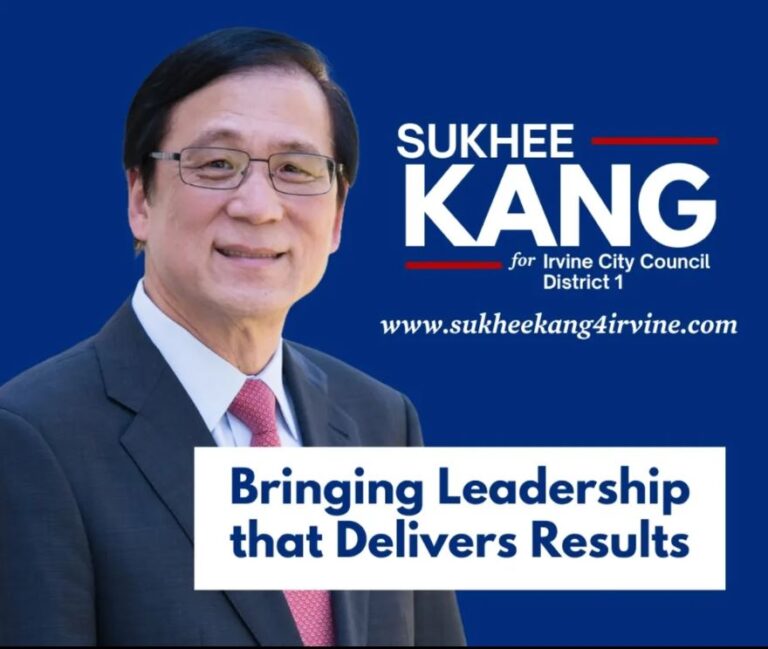
Friends may remember the name: Sukhee Kang. Sukhee is one of those common cases where political ambition to hold office leaps far ahead of ability or commonsense.
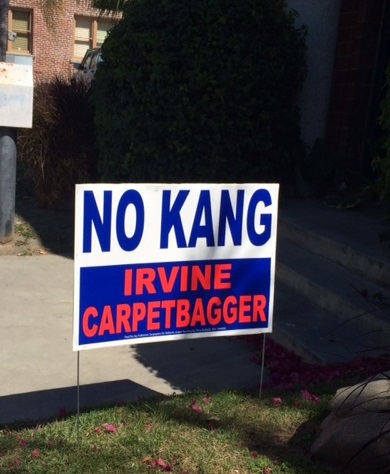
Way back in 2016 Sukhee quit Irvine where he had been a Larry Agran flunky on the city council and bought himself a mini-McMansion on a Fullerton golf course, behind a security gate. Remember? Mr. Kang’s lust for higher office caused him to carpetbag in order to run for the State Senate. I seem to remember one of his lackeys in Irvine defended this foolishness as a sensible “empty nester” move and downsizing on the part of Sukhee and Mrs. Sukhee.
Sukhee got schooled…
As usual, Sukhee had a phony ballot designation as an educated (he taught some made-up footling class at Chapman) and he was an author, too, producing a self-published biography. Sukhee promoted the fact that he was a veteran, although it turned out it wasn’t of our army.
The writing was on the wall…
Sukhee had all the usual endorsements – loads of Dem politicians, the sort of thing we now know is almost worthless. But Kang didn’t reckon with FFFF or Fullerton Taxpayers for Reform. He came in third and it was sayonara, Sukhee.
Anyhow, we learned shortly thereafter that the empty nesters had flown the coop – back to Irvine, demonstrating the bullshit of the rationalization.
I’m a leader. Larry told me to put that there…
Now Kang has kangaroo’d back into politics. He’s running for the Irvine City Council, a sad attempt of a 75 year old man to be relevant. It’s even sadder than an old dude trying to be important. The Irvine Council now has seven seats instead of five, and poor sad sack Sukhee has to run for a paltry district seat now.
Irvine District 1 residents may not even remembers this creep’s ditching Irvine just to run for an available office in a whole other town. Hopefully an opponent will remind them of Sukhee’s stay in Fullerton.
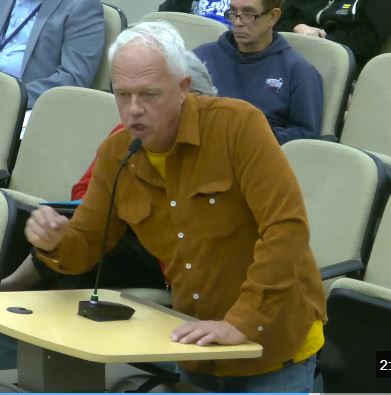
Somebody posted a comment the other day about some guy named Tim Johnson. I don’t know Tim Johnson, and I hadn’t even heard anything about him. I was directed to his performance at the last council meeting.
I would really worry about this guy’s mental and emotional well-being. Or I would if he weren’t such a puckered asshole.
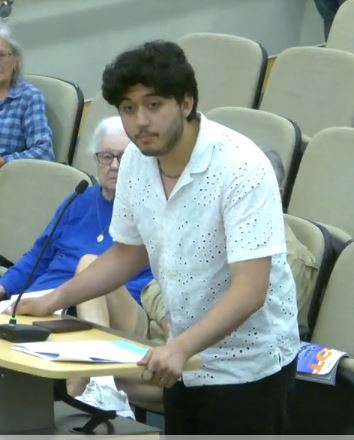
You can watch his performance on the City Clerk’s website. His diatribe starts at 1:49:35 mark, right after young Oliver, the No Account of Montecristo.
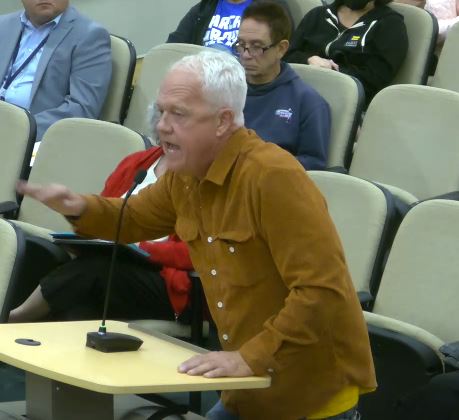
It’s become a rather worrisome trend lately for the harangues of a few malcontents at council meetings to vent their angry spleen in increasingly agitated, even violent language and behavior. This Tim Johnson individual is a good example.
Constantly slapping the podium; offering wild gesticulations; pointing at councilmembers; shouting angry and abusive language; this seems to be this person’s stock-in-trade.
There was no substance in Mr. Johnson’s diatribe except hatred for Fred Jung who has not been sufficiently contributory to making Fullerton fun! Like his kindred spirits at said podium he seems to think insulting people is an effective way to get them to do what you want. He also seemed to think he has a right for councilmembers to look at him as he denigrates them.
A little research suggests Tim Johnson organizes a bike parade on the 4th of July. His web presence is something called “Fullerton Loves.” He is therefore qualified to determine right from wrong.
Like many other local oracles he approves of those who gives him attention. Nick Dunlap does, apparently, and so does the relentless self-promoter Shana Charles, the otiose councilmember from District 3. The cops and firepersons go to his parades, I guess. And that is the launching pad for his little rocket: Jung makes backroom deals in a cigar lounge, etc., etc.
I’m glad there is a police presence at council hearings as a handful of angry people try to shout down councilmembers with catcalls from the back rows. The obnoxious Kennedy Sisters have already been escorted out for disrupting meetings. Sooner or later civility is going to have to be enforced by the FPD.
So it looks as if the City of Fullerton has finally decided to quit playing pat-a-cake with Jinan and young Oliver Montecristo. The owners of the restaurant Les Amis who kept encroaching on public property without approval or permits, and who serially dodged paying tens of thousands of dollars to the City in rent, are having their “improvements” on public property removed by the City.
Les Amis and unpermitted stuff…
Here’s the notification to the City Council from acting City Manager, Eddie Manfro:
Mayor Jung and City Council Members,
I was informed this morning that Public Works crews have removed the outdoor dining encroachments at Les Amis restaurant this morning. This follows the 90 day extension that she was granted by City Manager Eric Levitt. Following her payment of $3,900 on July 23, 2025, no further payments have been received.
According to Director Bise, Les Amis was provided with a 48 hour notice prior to removal of the encroachments. Public Works will hold it for 30 days in case they wish to keep it for their future use (but not for installation in the public space).
A copy of Mr. Levitt’s 90 day extension is attached for reference. Thank you.
Eddie
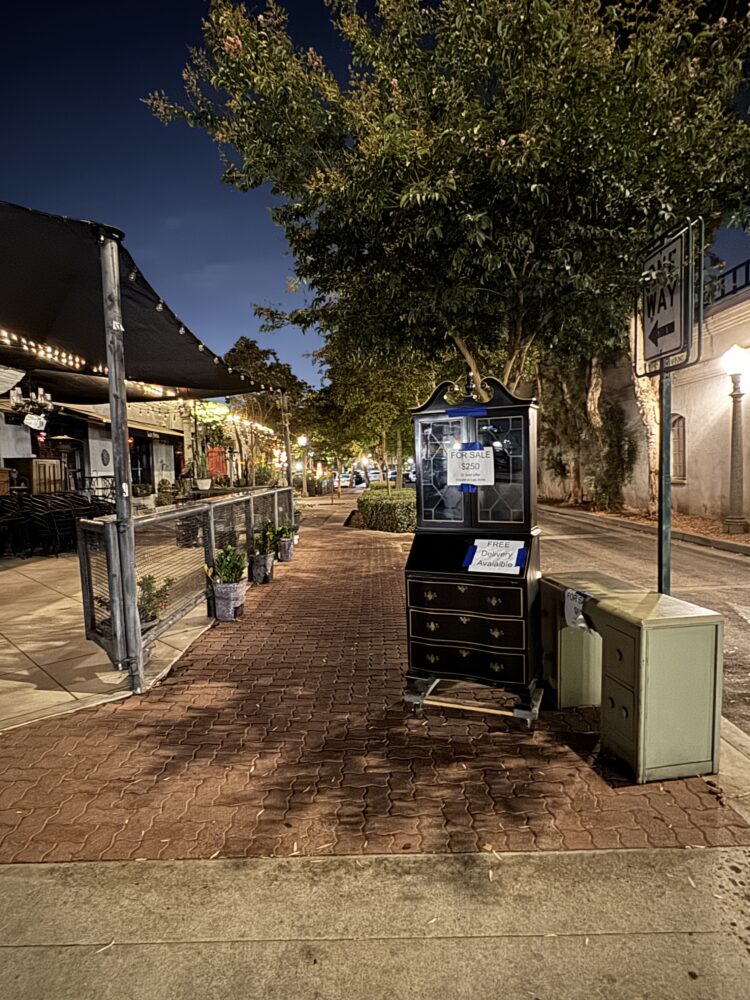
A yard sale is a small business!!
No doubt the suddenly “pro-business” folks at the Fullerton Observer, and “doctors” Zahra and Charles will continue to spin this into a David and Goliath story: little David being the scofflaws who have paid almost nothing to the City in rent for 15 years and who blatantly refused to follow City rules about squatting on public premises.
Poor Oliver
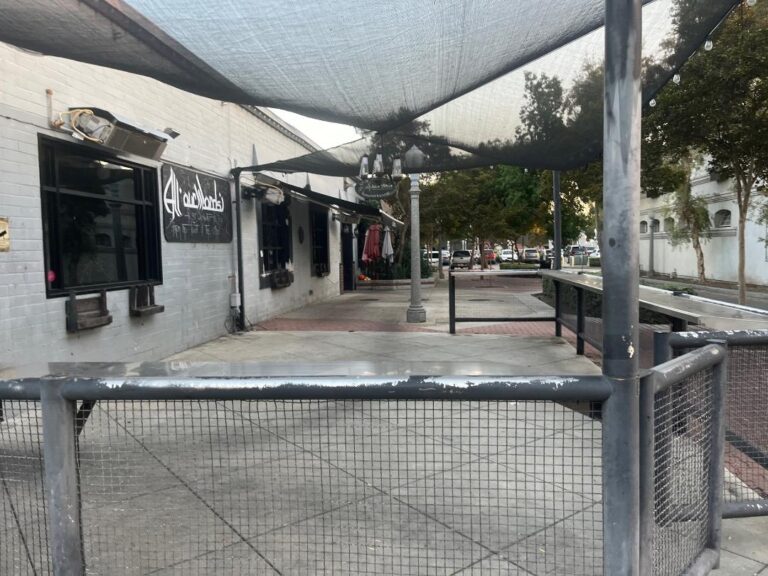
The last City Manager, Eric Leavitt actually gave the Montecristo mob yet another 90 days to make good on their debts and encroachments. Les Amis got a two day notice and still refused to do anything. So Public Works did. And the City has generously volunteered to keep the Montecristo junk on hand for a month in case they want it for some reason.
Les Amis sans meubles…
I really hope Jinan and Oliver get a bill for cost of removing their junk from the public right-of-way, although I doubt if they’d pay it.
And speaking of ever so earnest Oliver, I look forward to his appearance at the next City Council meeting blaming Mayor Jung for his own mother’s failure to pay her bills and play by the rules.
Thanks to a federal grant from the Federal Emergency Management Agency (FEMA) our city government is being presented with almost $3,000,000 to hire 12 new sworn fire department personnel and subsidize the new employees for three years to the tune of 75%, 75%, and 35%. The new hires will consist of three “Fire fighters,” three “Fire engineers,” and three “Fire Captains.” The City’s obligatory “matching” contribution is $1.8 million for those three years.
Another fire truck will be re-activated at Fire Station 6, requiring promotions of existing FFD underlings to take the vehicle to emergencies. This part of the item is not covered by FEMA.
It’s Item #14 on tomorrow night’s council meeting agenda.
If you want to read about it, here, you’ll see that the staff report is a virtual shell game of verbiage and is based on the notion that savings from the operation of the ambulance service hijacked by the FFD will cover the City’s new expenses; of course these “savings” are speculative – most likely the wishful thinking that goes along with empire building. There is not a single utterance about budget impacts now or in the out years.
Never a fire fighter around when you need one…
Sustainability? It would be nice to know what happens to these 12 positions after the three years are up and there is no longer any federal subsidy. Will these worthy folks be discharged in the name of budgetary constraint? Will they be kept on courtesy of cuts elsewhere? The new jobs will have to have pension costs now, and of course in the future which jack up our required payments to the good folks at CalPERS. On these issues the staff report is silent as a tomb.
There it goes…some might come back. Less overhead!
It’s long been a tenet of conservative principles that these dispensations of largesse from Washington and Sacramento are sort of like a pusher getting his junkies reliant on his dope. Here, specifically I have to wonder why FEMA is even in the business of increasing fire department sizes and budgets and the obligations that go along with that augmentation.
Obviously the agency that is known for helping communities’ response to big crises, mostly of the natural disaster kind, now has a remit and a budget to hand out money without reference to any disaster at all. And that budget most be pretty damn big if Fullerton can get a $2.8 million commitment.
Wouldn’t it be nice if the federal revenue that pays for this were kept at home, in the hands of the taxpayers and their local representatives, in the first place.
Got noise? Lots of noise? The two “doctors” on the Fullerton City Council and their followers like the Kennedy Sisters and tender young Elijah want you to believe this is vibrancy and culture and small business success!