UPDATE: I just re-read this wonderful post from my good friend Joe Sipowicz that he published last November. Damn. Read it. Savor it.
When you are done ask yourself whether or not, in good conscience, anyone can fail to endorse, help and vote to recall the Three Dim Bulbs.
– Grover Cleveland
There is a good essay in today’s Wall Street Journal by Holman W. Jenkins, Jr. about the sort of trouble individuals can get into when they act, or fail to act, to shield and protect the institution they represent. And, conversely, the institutions that invest too much credence in the all too fallible figurehead run the risk of failing to employ objective and rationale controls on the latter. As decades of affiliation pass, the problems becomes more acute. Age becomes the enemy.
Of course the writer is talking about Joe Paterno and the disastrous and disgusting pedophilic events at Penn State University. But he may as well have been talking about Fullerton, and about how, after the Kelly Thomas murder, when the public demanded clear, honest, and forthright leadership, their long-term elected officials gave them silence, obfuscation, falsehood, and comfortable retreat behind legal advice they were all too eager to embrace.
Don Bankhead, Dick Jones, and Pat McKinley signally failed their constituents by placing the protection of City Hall and the FPD ahead of their responsibility to do what they were elected to do: lead. Did they ever even attempt to fathom any particle of the truth? Would they recognize it if they saw it? It hardly matters now.
At first it probably seemed easier to simply ignore the Kelly Thomas killing; a whacked out homeless guy versus Fullerton’s Finest? Strictly no contest. After all there was a fight; bones were broken; the bum was a thief; probably a drug addict; an internal investigation would reveal all. Sure, Chief, take your two-week cruise.
Indifference to the victim and the victim’s family, although demonstrating a fundamental callousness, was the least of their dereliction.
Later as the pressure mounted and the glare of the media spotlight became intense, McKinley and Jones began to utter incompetent and ignorant remarks for consumption by the nation and the world: facial injuries are not life threatening; far worse injuries were survivable; the Coroner cannot determine the cause of death.
As public meetings became rancorous they relied upon the monotonous drone of their attorney to explain to an outraged public why they were weak as kittens and powerless to control any part of their own police department.
And they refused to display any concern about why the FPD brass had permitted the cops to review and re-review the evidence that the public is not permitted to see; why their superiors made them re-write their reports of the killing; and why the culprits were permitted to return to duty as if nothing had happened. They ignored the fact that the police department spokesman had lied about cops’ injuries and had deliberately mischaracterized the killing to the public and to the City Council. They never addressed the fact that the “internal investigation” hadn’t even started.
The police chief, freshly returned from his cruise soon wilted like an old lettuce leaf. His replacement was a 30 year veteran of the same department about which a string of criminal behavior had recently been exposed. Bankhead, Jones and McKinley refused to accept what had become obvious to almost every one else: something was fundamentally wrong in the FPD.
As the weeks passed, Bankhead, Jones, and McKinley seemed to hope that temporizing and protracted investigations by the DA and Coroner would cause the situation to just wither away. It didn’t. The protests for justice got louder. Their answer? Characterize the protesters as a lynch mob.
The most telling gestures of all were the damage control employment of an outside investigator, and the appointment of a hand-picked committee to address homeless problems, hilariously suggesting that the real problem was that the poor cops just weren’t properly educated about how to deal with the homeless. The concept that Kelly Thomas was deliberately killed seems not to have been seriously entertained by Bankhead, Jones, and McKinley. No. The Fullerton Police Department doesn’t do that. Fullerton doesn’t do that. We don’t do that.
When the DA finally brought charges of Murder and Manslaughter against two of the cops Jones expressed elation and McKinley befuddlement as to how two of his boys could stray so far from their training. But it was clear that the damage control script was written to write off the two and then retreat back into their insulated bunker.
And yet, by now the public now knew all about what the Three still refused to acknowledge: the embarrassing string of stories of drug addiction, theft, fraud, brutality, false arrest, perjury, and sexual assault by members of the police force. This serial criminality has been met with a stony silence from Bankhead, Jones and McKinley. Why?
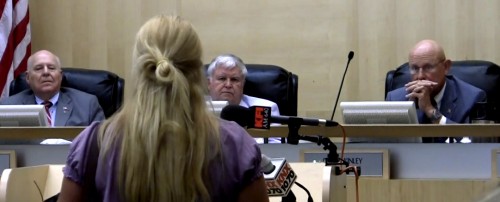
It’s because if they ever could, they can no longer distinguish right from wrong when it comes to protecting the institution that they have come to completely identify themselves with. Those Fullerton lapel pins that they so proudly wear have become a symbol of inertia, dereliction, and blind dedication to an abstraction of their own creation: their own delusional view of themselves and their City. It is a perfect representation of the bunker mentality.
As with a sick patient, denial and inaction will only cause the illness to get worse. The patient is the City of Fullerton, and in the now-ironic words of Dick Jones, it is having a grand mal seizure; we don’t want to let go of the patient, but we need to get it under control. Damn straight. The patient needs medicine, all right.
And the medicine is Recall.