The Strange And Terrible Knowlwood Saga

knowlwood2
A gosh darn barn right here in Downtown Fullerton!

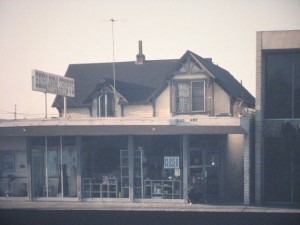
20 years ago the buildings at the SE corner of Harbor and Commonwealth burned down under strange circumstances, including what was left of the Sterns and Goodman store (why do historic structures keep burning down in Fullerton?). Unbeknownst to the good folks of Fullerton, perhaps the worst example of Redevelopment ineptitude was about to begin.

The owner of the property, Pierre Nicholas, proposed to build a bank building on the corner – a suitable use for the 100% corner any reasonable person would have to agree. But not the entrepreneurial geniuses who ran the Redevelopment Agency at the time – Terry Galvin and his boss Hugh Berry. The problem? Banks don’t generate any sales tax revenue and that’s what Redevelopment is all about. At one hearing a defensive Councilmember Buck Catlin exclaimed “they wanted to build a bank” with the same tone of disgust one might mention a whorehouse or an opium den.

And so Friends, the City embarked on a course to acquire a lengthy ground lease to prevent  the owner of a property to  develop it the way he wanted . Nicholas went along. Why not? Income with no effort on his part.

The Redevelopment bureaucrats already had their favored developer lined up – Sanderson/J. Ray (from Irvine!)who, in cahoots with the City, had worked out a deal with Knowlwood Restaurants to occupy a restaurant on the southerly part of the site.

The subsidized Kwowlwood was eventually ground out of the Redevelopment process – a barn shaped object clad in stucco and brick veneer (pictured, above). Yeehaw!

Meanwhile the development of the corner languished as the developer was finding tenants, and presumably a loan, hard to come by during the early 90s recession. The developer did get permission to put parking lot on the corner and just added insult to injury. The 100% corner –  a parking lot!

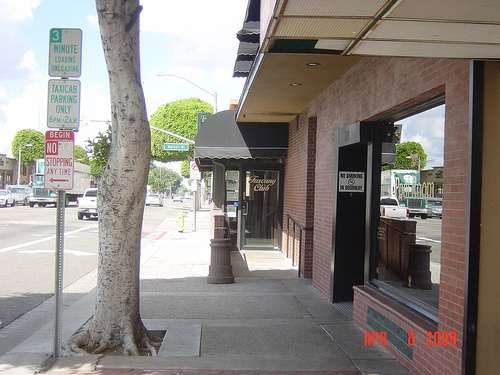
By 1995 the project was finally moving ahead. The developer proposed a stucco palazzo with a ludicrous dome covered with green glop. But worst of all the entire second floor was a fake! The developer still couldn’t rent it out and decided to do a movie set storefront instead.  Check out this image:

As a Phallic Symbol It Comes Up A Little Short
The roof is a giant bowl! This is not a joke. Just check out the picture below if you can’t believe it. The City’s heretofore 5 year saga was reduced to this sort of comic charade. Lights were placed on the floor of the area directly behind the windows to make it look like there was real space up there. To top off the irony, the designer of this mess actually got offended by the suggestion that the geraniums in the second floor planters be plastic to save water!
Maybe It Could be Used As A Swimming Pool
Maybe It Could be Used As A Swimming Pool During The Summer
Well, the City Council went along with this fiasco from start to finish with the exception of Chris Norby. And none of them ever did anything to act on their displeasure if they even experienced such an emotion in the first place. They were:

Molly McClanahan (former Councilmember and current NOCCCD Trustee)
Don Bankhead (current Councilmember)
Dick Ackerman (former Councilman, Sate Assemblyman, and State Senator)
Buck Catlin (former Councilmember)

and, lest we forget:

Julie Sa (twice elected former unintelligible Councilmember, current whereabouts unknown)

By the time the building was built and occupied 7 long years had passed – 7 years of lost property tax, and the addition ludicrous new buildings that never should have been built in the first place. For many Redevelopment watchers “Knowlwood” has become synonymous with Redevelopment boondoggles.

Oh well! As Molly McClanahan was once heard to say: hindsight is 20/20! An excellent motto for the Fullerton Redevelopment Agency.

The No Tell (Allen) Hotel – What Goes Around, Comes Around

Gee, Molly. You Didn't Think We Would Remember, Did You?

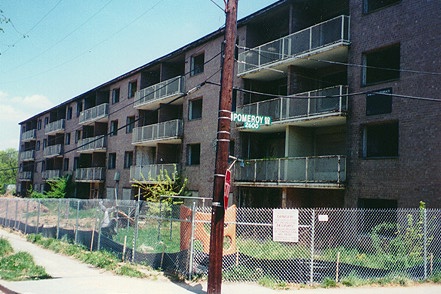
Almost twenty years ago Fullerton made its first significant foray into the quagmire of affordable housing, acquiring the the Allen Hotel and turning it over to a fellow named Jose Zapeda. Mr. Zapeda’s job was to accept a huge subsidy to “renovate” the original building and build a new addition. Apartments were to be low income.

The total taxpayer payout exceeded one million dollars – a tidy sum, to be sure – over $70,000 per unit, in fact. Cynics claimed that the exorbitant subsidy was just a way to buy down the quickly escalating affordable housing spending requirement of Redevelopment law that the City had ignored for years.

The usual suspects were on board. Perhaps the most comical (and racially charged) comment came from then City councilmember Molly McClanahan who bragged: “we’re giving them one of their own” as if Mr. Zapeda, because he was Mexican American, was more qualified to build and run a low income housing project – inhabited by – Mexicans!  Molly also proclaimed that she liked the simplicity of the proposal, as if a stucco box with flush vinyl windows and stick-on brink lintels over the windows was somehow virtuous.

dsc00256
Allen Hotel - The Once and Present Tenement

The replacement of the original fenestration with plastic windows, and the transom glass with fake leaded lights (grid glued on the back!)  just showed that historic preservation was being used as a pretext for the big subsidy. With the passing of the years it’s truly hard to see how this eyesore has avoided targeting by Redevelopment as blight – since it was blighted from the moment its “designer” put pencil to paper.

Does Fullerton Hate Modern Architecture?

We Really Like This
We Really Like This Sort of Stuff

It’s bad enough that the City of Fullerton has always shown a penchant for fake old, with its attendant brick veneer and styrofoam cornices. Sooner or later we may actually come to accept this affront to taste by the bureaucratic boobeoisie. What really adds insult to injury, however is the cavalier way that modern architecture is treated by the City. By “modern’ we really mean functional, original architecture that encloses space creatively that employs abstract patterns, uses modern materials, and that expresses its structure in its outward appearance.

32424589551_f8119ca3781

What really bugs us was to watch last year’s “Jefferson Commons” abomination approved unanimously by the City Council. Bad enough was the proposed monstrosity; we’re used to architectural crap. Even worse was the propsed demolition of three mid-century modern gems on Chapman Avenue without so much as a backward glance.

3424582647_9cd14b8cec

So why do we bring this up again? Last night the Council voted to extend the permit deadlines for an additional two years since the new developer (the old one already bailed out) can’t get financing. Several speakers pleaded the case that the buildings in question have historical merit that was not recognized by a faulty CEQA process (wow, no surprise there!), and that demolition should be postponed at least until a final project looks like it could start. These seem like a pretty prudent path to us.

Why these buildings were not originally identified as historic resources is not hard to explain. The City ignores anything not listed on their register of significant buildings; that accomplishes the bare minimum of CEQA requirements, but doesn’t say much for the integrity of the process. The out-of-town lobbyist had done a good job of spreading around the wealth and the buildings never stood a chance. Meanwhile, Fullerton’s Heritage group, that should have been raising Holy Hell, was apparently too busy putting brass plaques on things and telling NOCCCD administrators how much they prefer fake old to modern architecture.

Where’s the Blight?

map1At its May 5 meeting, The Fullerton City Council will consider expanding the city’s redevelopment area by 1,165 acres. This would place nearly 25 % of the entire city under the redevelopment agency, with its expanded powers to use eminent domain, divert property taxes and subsidize development.

State law allows the creation or expansion of redevelopment areas for only one reason—blight.

Blight is a legal requirement. Without it, a redevelopment area can be thrown out by the courts, as has been done with the cities of Mammoth Lakes, Temecula, Glendora and Diamond Bar. Judges are loathe to allow more revenue diversion unless the law is respected. The proposed expansion would place much of Southeast and Southwest Fullerton’s commercial areas under redevelopment. Are they blighted?

picture1The allegedly blighted area abuts my College Park neighborhood, along Raymond Ave. It includes a new Walgreen’s, the original Polly’s Pies and the Albertson’s where I shop. South of the tracks lies the newly-built Valencia Industrial Park, leased to near capacity, and the bustling Home Depot. It includes multinational distribution centers such as Yokohama Tire, UPS, Alcoa Aluminum and the Kimberly-Clark plant.

The council is being asked to declare as blighted all 167 small businesses along West Commonwealth, stretching from Euclid to Dale. All of these business owners must realize that a blight designation automatically makes them subject to possible future eminent domain.

atnip1Also blighted would be the new Fresh’n’Easy shopping center at Euclid & Orangethorpe. The proposed blight includes the Fullerton Municipal Airport and adjacent aviation businesses. It includes unique regional specialty retailers on Orangethorpe like Bob Marriott’s Fly Fishing Store and the Harley Davidson Center, both the largest of their kind on the West Coast.

Urban Futures Inc. conducted the city’s blight report, which studied conditions in the proposed expansion areas. It found that out of 629 buildings, only 5% were deteriorating. Less than 2% of the all parcels are described as incompatible. In the proposed project area, sales tax revenues grew 50% faster than in the rest of the city. There is no blight to legally justify the expansion.

fishing-storeExpansion means the agency will divert even more property tax funds from local government. Statewide, 10% of all property tax revenues are diverted by redevelopment agencies—that’s $5 billion annually. Most of this is at the expense of public schools, which then must be backfilled from the state general fund. But the state is now broke, and the backfills can’t be maintained without the massive new tax hikes proposed for the May 19 ballot. Redevelopment also diverts funds from the city’s general fund with an estimated $100 million loss to the municipal budget over 45 years.

Here in OC, RDAs now consume 15% more property taxes than all of county government. The County of Orange has lost $190 million to redevelopment agencies since 1990. This translates into real cuts in public services. We must defend our public revenue stream against future diversions.

With these funds, RDAs typically assemble land (under threat of eminent domain) and subsidize new retail development. Costco alone has received $30 million in public money just in OC, while Walmart has gotten over a $1 billion nationally in tax subsidies. The promised revenues rarely materialize as sales taxes are simply shifted from one area to another. Subsidized corporate big boxes soak up the sales that used to go to small businesses.

In 1998, the respected Public Policy Institute of California conducted a comprehensive study of redevelopment areas throughout the state. This groundbreaking report “Subsidizing Redevelopment in California” found no net economic benefits that justified the huge public expenditures.

fake-2nd-floor3392135869_b2ae8a32751Compare the three shopping centers at Harbor and Orangethorpe: Metro Center and Fullerton Town Center received massive public subsidies, while Orangefair was built and recently improved with purely private money. Compare the Knowlwood complex at Harbor and Commonwealth (with its fake second story), built with $510,000 in RDA subsidies, next to privately built Stubrik’s and Slidebar.

RDA funds can be used for purely public projects. While a member of the Fullerton City Council, I did vote for redevelopment funding for infrastructure, parks, libraries and the Maple School rehab. maple-school3392113811_21cf1eec3eBut the temptation to get involved in purely private commercial ventures makes city government a major developer and landowner.

Because of site-based sales tax allotment, cities typically use redevelopment to subsidize new retail centers. Auto malls, shopping centers and multiplexes have all been built with public funds. With retail centers now overbuilt and languishing, where is the market for all these new taxable sales? With property values plummeting, when will any additional property tax increment materialize?

Fullerton’s current RDA areas were created when blight standards were vague and unenforced. Subsequent laws require blight to be definitively proven. Judges have little tolerance for city governments simply seeking to expand power and revenue at others’ expense.

As a county official, I’m concerned about redevelopment’s impact on public services. As a Fullerton native, I’m concerned about an official declaration that 25% of my hometown is blighted. If redevelopment really has cured blight in our city, why does it continue to grow after 35 years? If there is no blight, why are city officials so eager to flout the law and denigrate Fullerton’s true condition?ns3392235153_c2af9988b52

At our June 17, 2008 meeting, the Orange County Board of Supervisors voted 5-0 to oppose the proposed Fullerton RDA expansion. The opposition was based on the feared loss of County revenues and County Counsel’s opinion that there is no blight to legally justify the expansion.

Fast Talking Techno-Pitch Man Tries to Sell Council Sack of Magic Cyber-Beans

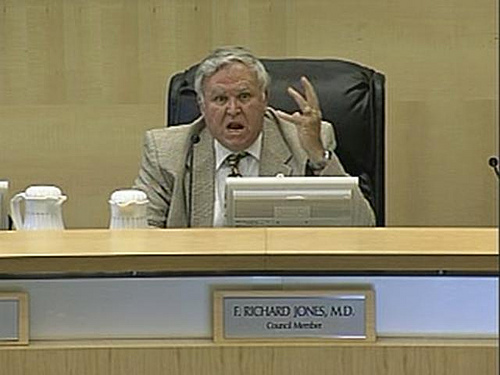
Council member Mr. Dick Jones was caught drooling yesterday at the idea of using taxpayer funds to create a massive fiber optic nightmare to compete against local businesses and bring high-speed Internet connections to our supposedly media-starved school children. A presentation was made to the council by smooth-talking Paul Stover of the Technology Working Group to deploy a 37-mile fiber-optic loop buried shallowly underneath major Fullerton traffic arteries. Mr. Jones seized upon the idea of becoming his own telecom corporation, using taxpayer resources to launch Fullerton into the high-risk world of the telecommunications business. Despite his lack of experience in the telecom industry and without surrendering a moment to ponder the idea, Mr. Jones eagerly pronounced “I’m ready to sign up!”

In the corporate world, responsible executives must keep a tight reign on their computer geeks, who are easily coaxed by fast-talking technology salesmen into spending other people’s money to buy themselves fancy new toys. Mr. Jones and the rest of the council should always be wary when IT salesmen throw around meaningless buzzwords like “Futureproof” and “knowledge workers” in an attempt to justify fabulous new financial ventures deep into the territory of private enterprise.

Council member Shawn Nelson got started with some important questions, but the council needs to go much deeper. These are the questions you should be asking TWG and ISMS (the consulting company who conveniently recommended themselves to manage the proposed system). Vague, assumptive or misdirecting answers should not be accepted.

1. Should we make a long-term investment into a rapidly-depreciating commodity? The cost of bandwidth has been falling by orders of magnitude for the last 15 years and is expected to fall even faster as ISPs trip over each other to deliver high-definition video to every home in America over the next few years. Is that the low-margin business that the City of Fullerton should enter? Or perhaps we should position ourselves to benefit from the fruits of this new competitive marketplace by leaving ourselves open to the most efficient solution utilizing commercial economies of scale that a city can never achieve by itself.

2. Do our children really need gigabit Internet connections at school? Some of our teachers seem to be very interested in bringing more bandwidth into our schools to fill our children’s mind with the best videos that the Internet has to offer. For as far back as I can remember, projectors, VHS and DVDs were used by lazy schoolteachers as babysitters in the classroom when they don’t feel like actually teaching. Will Internet video be any different? Why are these teachers so quick to outsource themselves to a video professor?

3. Why does the network have to be physically owned by the city? ISMS disingenuously implies that their giant list of potential uses for this fiber network can only be achieved if Fullerton owns the physical medium. That is completely false – any and all of these technologies could be run over network access provided by the marketplace on an as-needed basis.

4. Will Fullerton really be able to re-sell portions of the network to businesses? Mr. Jones clearly became enamored with the idea, but the TWG spokesman downplayed it and suggested that it was merely a possibility. Almost all businesses have connectivity needs that go beyond the borders of a single city and would be wary in signing up for government-run service in a competitive marketplace.

5. What are the risks of microtrenching the new cable? Microtrenching is a newer cable distribution method which only buries the cable about a foot under the surface of our roads instead of digging large trenches. Are there any long-term reliability studies of this new technique? If we lay 37 miles of cable over the top of our existing utilities, what are the increased costs when we have to do maintenance to our gas lines, sewer lines, water mains and street surfaces?

Mr. Jones may be easily bedazzled by big words, flashing lights and his own jokes, but the rest of the council should be wise enough to ask the right questions before taxpayers are sold on this so-called Fiber Field of Dreams.

SUSTAINABLE DESIGN IN FULLERTON?

Dave Musante knows it takes a long time to bring about positive change in cities. Right now the first LEED-certified affordable housing development is being built in Northampton Massachusetts, where Dave was first elected Mayor for 12 years. What did they name the street that leads to the project?

Dave was advocating sustainable planning elements–greenbelts, energy conservation features, etc. way before he left office back in 1992. So 17 years later, when this project became a reality, the planners said its street sign had to say “Musante”.

Now that Sharon Quirk has reappointed him to the Planning Commission for the next four years, we can anticipate his outspoken advocacy for sustainability in public projects here in his new hometown? Will the Fullerton Redevelopment Agency’s planned $30 million government-subsidized Richman Ave. housing project adjacent to the historic Jones and Emmons neighborhood live up to the standards Dave pushed for in Northampton. Stay Tuned……

CITY COUNCIL TURNABOUT STICKS IT TO OLD GUARD

In a surprising move Pam Keller and Sharon Quirk performed a U turn at last night’s council meeting on the subject of commission appointment process. At the “first reading” of a new ordinance the proposal was defeated 3-2, with the support of Shawn Nelson.

Although previously supporting the jettisoning of direct appointments and replacing it with the old, cumbersome interview process, both Keller and Quirk, upon reflection, decided that exercising individual authority and accountability is part of the responsibility of being elected to public office. We commend them for making the right choice.

As expected, council mastodons Bankhead and Jones refused to emerge from Fullerton’s last ice age, and vociferously defended the old interview process in which retired government statocrats such as themselves had a disproportionate amount of influence choosing appointees of like mind and temperament.

The process of filling “at-large” commission seats will now be handled in special council sessions, in public. To which we respond – bravo! Transparency and responsibility!

Someday, perhaps the council will simply abandon these at-large seats and operate with five member commissions, each member of which responsible to his or her elected representative. In the meantime we congratulate the majority of the council for doing the right thing.

FULLERTON CITY COUNCIL VOTES TO EMASCULATE SELF

On January 6th, a 4-1 majority of the Fullerton City Council perpetrated a strange act of self-mutilation, with Shawn Nelson dissenting. It decided to revoke its policy of selecting people to serve on commissions and committees. Instead of individual councilpersons being able to choose direct appointments, they returned to the old system whereby a couple of councilpersons and a commission member conduct interviews and make recommendations for approval by the entire City Council.

So effectively a majority of the City Council chose to disempower itself by abdicating the ability to choose their own direct representatives on commissions.

Now why would politicians give up direct appointment for the diluted old groupthink process? A good question, and one only partially explained by the typical Fullerton city councilperson’s fear of actually exercising the power the electorate has bestowed upon them.

Historically, the old system of interviews meant that certain candidates could be effectively weeded out or ignored altogether. And what was the profile of these undesirables? Independence and a willingness to question the bureaucrats in City Hall were likely character traits; or, to put it another way, the process effectively ensured the type of person who was selected. The latter was inevitably chosen for his or her willingness to be a team player, to go along with the recommendations of “staff” and who could be counted on not to ask embarrassing questions and expect coherent answers.

Furthermore, since the commissioners were not directly accountable to anyone they were even more likely to identify with the staff department that oversees its respective commission, than with any elected official’s policy. This fact may comfort those who find politics distasteful, but it results in a diffusion of authority – a vacuum into which bureaucratic inertia will inevitably insinuate itself.

Appointing people who are safe who through personality type, or can be relied upon to run with the herd in order to protect their business interests would certainly appeal to Dick Jones and Don Bankhead – retired Air Force doc and cop, respectively. It was the retired bureaucrats themselves who always had a disproportionate influence in this system since they had ample time to the interviewing.

We associate this sort of corporate thinking from men once in uniform. But what of the two avowed liberal members of the Council, Sharon Quirk and Pam Keller? Liberal women might not be expected to adhere to the lockstep logic of military teamwork. To them we may attribute a liberal, process-oriented view of things in which the more convoluted an operation is in masticating its material, the more digestible the product must be.

And finally, we must note that the practical consequence of this council’s castration will be to deprive current Council pariah Shawn Nelson with the opportunity to make his own direct appointments to commissions; and since he might actually appoint people likely be independent-minded and represent the taxpayers instead of the bureaucracy his colleagues will certainly be gratified by denying Nelson this prerogative – even if it means depriving themselves of the same privilege.

4:1 Fullerton Council “Clueless” Ratio

Below is a link to a video of the January 6th Fullerton City Council meeting. Try this. Jump to item 14 and watch the various members discuss the proposal to RETROACTIVELY increase city employee pensions. Your challenge in responding to this post is to explain how any member other than Shawn Nelson does not appear to be clueless. In all fairness, Pam Keller may have escaped “clueless” status in this segmant as it was unclear as to when she figured out that the proposal was a bad idea. But for Quirk and Bankhead, it was as though somebody just let them know that the earth isn’t flat and they’re pissed. Heads are going to roll. By essentially implying to Nelson that opposing defined benefits to public employees is unconcionable, Bankhead is literally arguing that the math should be damned. It’s really worth the watch for the entertainment value alone if you know the players. Warning. If you were hoping that Sharon Quirk had a basic understanding of her responsibilities, have a martini first because you are about to be enlightened. http://fullerton.granicus.com/MediaPlayer.php?view_id=2&clip_id=127